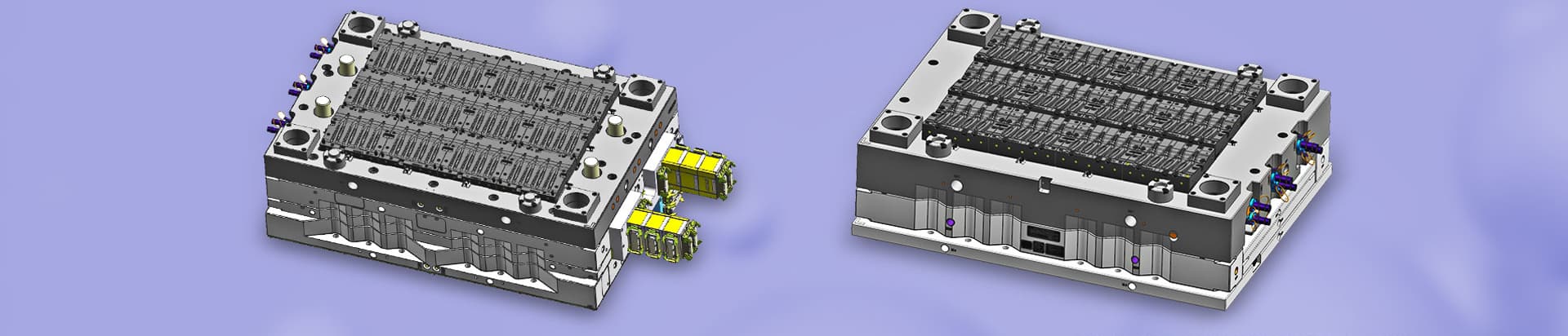
Common defects related to heat treatment refer to various problems that appear during final heat treatment, subsequent processing, or actual service life. These include quenching cracks, excessive dimensional distortion, inadequate hardness, EDM cracking, grinding cracks, and premature mold failure. A detailed analysis is provided below.
Geometric effects: Caused mainly by poor design, such as insufficient fillet radius, improper hole positioning, and abrupt section changes.
Overheating or burning: Results from inaccurate temperature control, system drift, excessively high process temperatures, or uneven furnace conditions. Solutions include calibrating temperature controls, adjusting process temperatures, and using support pads between workpieces and furnace floors.
Decarburization: Caused by overheating, unprotected heating in air furnaces, insufficient machining allowance, or residual decarburized layers from forging or pre-treatment. Preventive measures: use controlled atmosphere, salt bath, vacuum furnace, or packed heating with anti-oxidation coatings; increase machining allowance by 2–3 mm.
Improper cooling: Due to incorrect quenchant selection or excessive cooling. It is necessary to understand the cooling characteristics of quenching media or apply proper tempering.
Unsatisfactory steel microstructure: Such as severe carbide segregation, poor forging quality, or improper pre-heat treatment. Solutions: apply correct forging processes and establish reasonable pre-heat treatment procedures.
Improper loading or immersion in cooling tanks. Adjust process temperatures, calibrate temperature systems, space workpieces properly, and avoid bulk or bundled cooling.
Excessively high quenching temperature caused by incorrect settings or control errors. Correct process temperatures and recalibrate control systems.
Over-tempering caused by high tempering temperatures, faulty controls, or charging when furnace temperature is too high. Adjust parameters, repair instruments, and charge only at the set temperature.
Inadequate cooling: long pre-cooling, wrong quenchant, overheated medium, poor agitation, or high extraction temperature. Solutions: reduce transfer time; control oil temperature at 60–80°C and water below 30°C; refresh or replace media; improve circulation; remove parts at Ms + 50°C.
Decarburization from raw materials or heating. Use protective atmospheres, salt baths, vacuum furnaces, or anti-oxidation coatings; increase machining allowance by 2–3 mm.
Although experience and trial-and-error remain dominant, understanding the relationships between forging, steel orientation, geometry, heat treatment, and distortion — and establishing databases from practical data — is highly valuable.
Decarburization reduces hardness, promotes cracking and distortion, degrades chemical heat treatment results, and severely reduces fatigue strength, wear resistance, and mold performance.
Avoid overheating and decarburization; apply full tempering to reduce residual stress.
Use high-temperature tempering to relieve quenching stress. Select steels resistant to high-temperature tempering (e.g., DC53, ASP-23, high-speed steel) and machine under stable EDM conditions.
Perform stabilization and stress-relief treatment after EDM.
Design proper process holes and grooves.
Fully remove the recast layer to ensure structural integrity.
Use vector shifting to cut through stress-concentrated areas and release internal stress gradually.
Low toughness usually results from excessively high quenching temperature and prolonged holding, causing grain coarsening. It can also occur if tempering is performed within the temper embrittlement range.
Prevention: Apply cryogenic treatment after quenching, or perform multiple tempering (usually 2–3 times for molds, including low-alloy cold-work tool steels) to minimize retained austenite.
We are committed to providing customers in the automotive, power tool, home appliance, digital, and medical equipment industries with comprehensive mold, injection molding, and spray processing solutions and value-added services.



 Call us on:
  Email Us:
  1st Floor, Block1, No.3 Beiting Road, Houting Community, ShaJing Street, Bao'An District, Shenzhen City, Guangdong Province, China
  English
 Deutsch
 italiano
 русский
 français
 română
 العربية
 Español
 Polska
 日本語
日本語 한국어
한국어