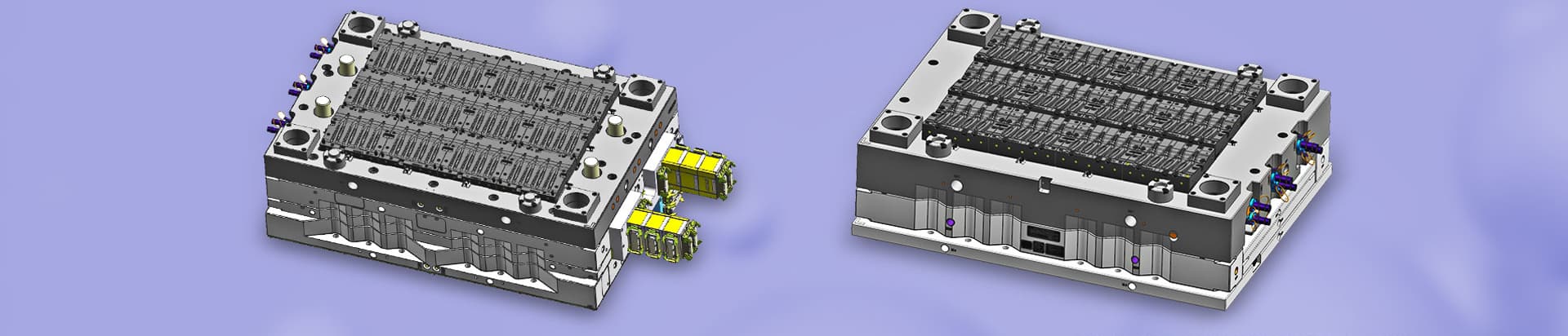
The insert pin is one of the precision mold parts. The insert pin enhances the strength of the thimble and prevents the thimble from being deformed or broken. As one of the important precision mold parts in the mold, the quality of the insert has a great influence on the normal operation of the mold, so the processing requirements of the insert are also very high. The insert needle must meet the following six requirements during processing, and the following is the answer for you!
1. The inserts of precision mold parts should have strong toughness
The working conditions of the insert needle in the mold are very bad, and it is often subjected to huge impact force, so it is easy to break. Therefore, in order to prevent the mold inserts from breaking suddenly during operation, the inserts must have high strength and toughness.
The toughness of the insert mainly depends on the carbon content, grain size and microstructure of the material, so the selection of the insert is very important.
2. The inserts of precision mold parts should have wear resistance
When the insert needle is plastically deformed in the mold cavity, it continuously slides along the surface of the cavity, and a huge friction force is generated between the cavity surface and the insert needle, and the insert needle is very easy to wear. Therefore, the material for making the needle should have strong wear resistance, which is one of the most basic and important properties of the needle.
The hardness of the material is also the main factor affecting the wear resistance. Generally speaking, the higher the hardness of the insert, the smaller the amount of wear and the better the wear resistance. In addition, the wear resistance of the insert is also related to the chemical and physical form of the carbide in the material.
3. The inserts of precision mold components should have anti-fatigue fracture performance
In the process of high-intensity work, the needle is used for a long time in a cycle, which often leads to fatigue fracture. Its forms include small-energy multiple impact fatigue fracture, tensile fatigue fracture, contact fatigue fracture and bending fatigue fracture. The fatigue fracture performance of the inserts mainly depends on its strength, toughness, hardness, and the content of inclusions in the material. Therefore, the manufacture of inserts should select high-quality material suppliers, preferably imported materials.
4. The inserts of precision mold parts should have corrosion resistance
When some inserts work in plastic molds, due to the presence of chlorine, fluorine and other elements in the plastic, after being heated, strong corrosive gases such as HCI and HF are decomposed and eroded the surface of the mold cavity, making the surface rougher and making the inserts rougher. More wear and tear, thereby reducing service life.
5. The inserts of precision mold parts should have high temperature resistance.
When the insert needle works at a high temperature for a long time, the hardness and strength will decrease, resulting in an increase in the early wear of the insert needle or plastic deformation and scrapping. Therefore, the needle insert material should have high resistance to tempering stability to ensure that the insert needle can work at high temperature for a long time.
6. The inserts of precision mold parts should have resistance to cold and heat fatigue
The insert needle is often in the state of repeated heating and cooling during the working process, so that the surface of the cavity is subjected to tension, pressure and stress, causing cracks and peeling on the surface of the cavity, increasing friction, hindering plastic deformation, and greatly reducing the inlay. The dimensional accuracy of the needle, resulting in the scrapped needle. Therefore, such inserts that are often changed in hot and cold environments should have high resistance to cold and heat fatigue.
Therefore, in the process of inserting needles, we should pay more attention to meet the above requirements, so that inserting needles can play the greatest role in precision mold parts.



 Call us on:
  Email Us:
  1st Floor, Block1, No.3 Beiting Road, Houting Community, ShaJing Street, Bao'An District, Shenzhen City, Guangdong Province, China
  English
 Deutsch
 italiano
 русский
 français
 română
 العربية
 Español
 Polska
 日本語
日本語 한국어
한국어