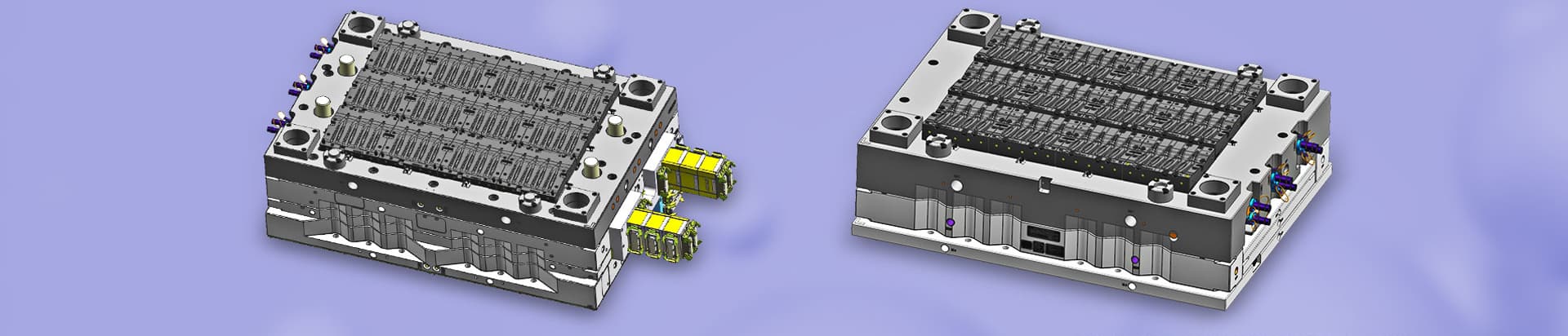
There are many kinds of CNC plastic molds, which can be classified according to forming material, forming process, loading and unloading mode, cavity number, parting surface characteristics, forming process, fixing mode and so on.
There are too many methods and the situation is complicated. This article will share some of the classifications of CNC plastic mold, so that you can understand its application and related knowledge more clearly. Knowledge is slowly accumulated, I hope you can always keep the enthusiasm of learning, learning endless.
Now let's get to know!
1. Injection Molding
At a certain temperature, the fully melted plastic material is stirred by screw, injected into the die cavity by high pressure, and then cooled and cured to obtain the method of forming products.
2. Extrusion Molding
Material through the role of extruder barrel and screw, while being heated and plasticized, while being pushed forward by screw, continuous through the machine head to make a variety of cross-section products or semi-products of a processing method.
3. Blow Molding
By means of gas pressure, the hot melt billet closed in the die is blown to form a hollow product. Blow moulding moulds only have negative moulds (concave moulds), which can shape products with complex undulating curves (shapes).
4. Gas-assisted moulding
When the plastic fills into the cavity properly (75%~99.9%) the inert high-pressure nitrogen gas is injected. The gas-driven melt plastic continues to fill the cavity. Gas packing is used to replace the plastic packing process as an injection moulding technology.
5. Vacuum forming
Vacuum moulding is often called suction moulding, which is a plastic processing technology. The main principle is to use the vacuum to adsorb on the surface of CNC plastic molds after heating and softening the flat hard plastic sheets, and then to form after cooling.


 Call us on:
  Email Us:
  1st Floor, Block1, No.3 Beiting Road, Houting Community, ShaJing Street, Bao'An District, Shenzhen City, Guangdong Province, China
  English
 Deutsch
 italiano
 русский
 français
 română
 العربية
 Español
 Polska
 日本語
日本語 한국어
한국어